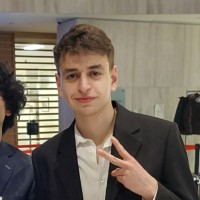
Benjamin Kaganovitch
- From:
- Jerusalem (moved to Canada at the age of 2)
- Age:
- 20
- College:
- University of Toronto, Mississauga
- Major:
- Computer Science
- Minor:
- Physics
- Career:
- The intersection of computer science with mathematics and physics-particularly AI and AGI — To contribute to quantum computing research
The Interview
Ben, how did you find out about The Podcast Fellowship?
Honestly, I found it through Instagram--I was scrolling and came across a reel about it. From there I got connected through my involvement in Jewish campus life. I am Treasurer of the Jewish Student Association at UTM and will soon be joining the Hillel Toronto board as UTM Campus Representative. Through those roles, I'm plugged into the broader campus Jewish ecosystem--Chabad, Olami, Ohr Somayach, The Maimonides Club--so once I came across TPF it felt like a natural fit.
Did you witness antisemitism on campus since October 7th, 2023?
UTM has a small Jewish community and a large international student population; the climate since October 7th has been difficult at times. As a JSA executive, dealing with antisemitism on campus is something we face regularly: posters, stickers and hostile messaging that we constantly have to address.
One particularly painful moment was when we were tabling to educate students about October 7th. The table was rushed by so many people that security had to shut us down and ask us to leave. We followed up extensively with Administration about how unacceptable that experience was.
Perhaps the most striking was that on October 7th, 2025--the same day the JSA was holding a commemorative educational event--the UTM student union published a post about 'honouring our martyrs." The student union is democratically elected; this post tells you something about the broader campus environment. I've also seen troubling material at the St. George campus.
The way I deal with it is by staying connected to community, refusing to be pushed away from my identity, and continuing to show up. If anything, it's made me more committed, not less.
Tell us about your Jewish family background, Ben.
My family background is Ashkenazi/Litvish, primarily from Belarus. On both my mother's and father's side, our roots trace back to the Gomel region, including the city of Rechitsa. What makes this especially meaningful in my family is that my father, Dr. Albert Kaganovitch, is an academic historian who has actually written about Jewish life in Rechitsa and Eastern European Jewry more broadly. So Jewish history isn't just something I learned about in school; it's something my family has actively studied, preserved and carried forward. I see myself as part of that chain.
You most certainly are! What was your home like growing up? What Jewish education did you receive?
I grew up in a home with a strong Jewish and Israeli identity. We knew our history and biblical stories, and we followed Israeli news closely, but we weren't observant in the traditional sense. My formal Jewish education was limited when I was young. Most of my real growth happened during university, where I've become much more engaged in learning, observance, Hebrew, and connecting with the Jewish community in a deeper way.
You found out about TPF on Instagram. Would you have been interested in TPF without the $15 stipend offer?
Absolutely. The stipend is appreciated, but the real value runs much deeper. The guided, facilitated learning structure keeps me consistent with my Jewish education in a way that stand-alone self-directed study doesn't. Beyond that, the networking has been genuinely impactful; through Rabbi Jaffit I've been connected to Jewish circles, fellowships and opportunities I wouln't have encountered otherwise. The mentorship turns what could be just podcast consumption into something much more meaningful.
Tell us about your experience with TPF.
Rabbi Jaffit (Rabbi Jonathan Jaffit of Ohr Campus) knows me well; he knows what I'm interested in and suggests podcasts accordingly. I prepare by listening carefully, writing down questions that come up, and thinking about how the ideas connect to my own life. What I've come to love about Jewish learning through this process is that asking questions is the point.
Our conversations often go deep, sometimes extending into metaphysics and philosophy in ways I didn't expect. For example, when we were discussing free will and G-d's omnipresence, we ended up exploring whether time itself is a measure of space, and what it means for G-d to exist outside of time. Those kinds of conversations---rooted in Torah but genuinely intellectually rigorous--are what keep me coming back.
Who is your favorite podcast speaker?
My favourite speaker is Rabbi Dr. Dovid Gottleib. He approches Jewish thought with real philosophical depth; his series on free will doesn't just present a Jewish position, it grapples seriously with the metaphysical complexity of the issue. He makes you sit with hard questions rather than rush to easy answers, which is something I deeply respect. It also connects naturally to the kinds of conversations I end up having with Rabbi Jaffit.
Where do you stand in your Jewish observance today?
I'm still on the journey, but I'm much more connected than I was. I try to put on tefillin, I attend synagogue more regularly, I'm actively learning Hebrew, and I'm always looking for ways to make Judaism more central to my life. I don't think of it as a destination; it's a continuous process, and I'm trying to move forward.
Ben, can you sum up your experience with The Podcast Fellowship in one quote?
“A podcast can give you ideas, but a conversation can turn those ideas into growth. The more I learn about Judaism, the more I realize how much there still is to learn--and that's exactly what keeps me coming back.”